This blog is meant to provide a wide variety of children's literature that can be integrated easily into the classroom. The activities provide ways to use these books in the already structured classroom setting. Good books are important for children in all grades. This list includes some of my personal favorites for all different grades!
Showing posts with label Mathematics. Show all posts

Tuesday, September 27, 2011

Chains by Laurie Halse Anderson

Chains 
(Atheneum Books for Young Readers-2008)
By: Laurie Halse Anderson
Grade: 5-7

Chains takes place at the beginning of the Revolutionary War. A thirteen year-old girl names Isabel is promised her freedom by her dying owner. Her owner was very compassionate towards her slaves and taught them to read and write. Miss Mary Finch, their previous owner in Rhode Island, had promised their freedom before she died, but she is instead, since there was no written proof, they were sold to a New York couple with her sister. As a result, her nephew inherited her estate and promptly sold Isabel and Ruth to the Locktons. Isabel and Ruth must do all they can do in order to get freedom, even if one of them spies on their owners for British secrets.This is a great book about determination and what it used to take to become free. The lives of these girls will hopefully make students be thankful for the lives they have.

Theme/Skills Taught: African American history, slavery, bravery, freedom/History of the Revolutionary war

About the Author: Laurie Halse Anderson says that no one who knew her as a child thought she would become a successful adult. She stuttered and needed a reading tutor growing up. In college, she avoided English because she hated the way they made her analyze books. She got her sense of story from eavesdropping on grown-ups telling stories. Initially, she worked as a journalist and completed work-for-hire writing projects to gain experience. But, after having children she grew a new love for literature. When Anderson first started writing for children, she had a day job. “I was sneaking in my writing in the morning and at night. Now that I’m a published author who’s had a lot of lucky breaks, I have a day job—designing my website, answering fan mail, speaking at schools and conferences. So I still sneak in my writing in the morning and at night.”  She feels fortunate to have had such an impact on children. If she had to predict how her life would have turned out, she would never have predicted her current success. For more information on Laurie


Pre-Reading Activities: A great way to introduce this story is to go over the title, "chains". The cover of the book gives some indication that the book is about slavery. Ask students what they already know about slavery? This is a great time to discuss "touchy" subjects to make sure the students know the facts about slavery. This could be used during a history unit to tie in real facts with this story.
Post Reading Activities:  
ELA & Social Studies: During a Revolutionary War unit, have the students create a diary of what goes on in the book, as if they are Isabel, Ruth, or Curzon (another way to summarize). This will be going on while they are reading the book and in each entry students will need to tie in something that accurately occurred in the war.  
Science: Research weather patterns and plant types in the region of New York City. Try to figure out what kind of seeds Isabel might have planted throughout the year to keep her garden going.
Math: Find the number of residents and slaves in New York City in 1776. What percentage of people were slaves? Create a graph to represent this information.

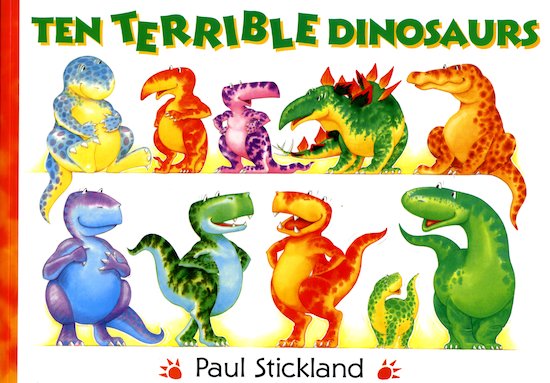
Ten Terrible Dinosaurs by Paul Stickland

Ten Terrible Dinosaurs
(Demco Media-2001)
By: Paul Stickland
Grade: K-2

Ten Terrible Dinosaurs is a great book about numbers. The dinosaurs count down from ten to one, which is a perfect introduction to subtraction to very young children. I also like it to teach fluency. Rhyming is a great way to teach kids how to flow when they are reading. I love reading rhyming books out loud and have them figure out the end of the rhyme. Everyone feels involved and we are having fun learning!

Skills Taught: Subtraction & Rhyming

About the Author: Paul Stickland has illustrated many popular books for children. He lives in Somerset, England with his wife and their four sons. He is the author, illustrator AND pop up designer of many very popular children's books.Creator of over 50 books, including Dinosaur Roar, Ten Terrible Dinosaurs, Dinosaurs Galore, The Christmas Bear, One Bear One Dog, A Number of Dinosaurs, Swamp Stomp,Truck Jam, Big Dig, Big Bug Little Bug and many more.He is really interested in using paper folding and pop up technology even outside his books. About Paul Stickland
Reading Activities: Before reading the book, you can go over (or count together) 1-10 to get them ready for the story. This book is relatively "simple" so I had an activity to do while reading the book: cover the number and have a student count the amount of dinosaurs. Have them complete the rhyme. That is always fun! It is great to show them the use of adjectives and how it can really bring a picture to life. Have them draw their favorite animals and describe it using as many adjectives as they can. Give them some examples to start.

Sir Cumference and the Sword in the Cone by Cindy Neuschwander

Sir Cumference and the Sword in the Cone 
 (Charlesbridge Pub Inc-2003)
By: Cindy Neuschwander
Illustrated by: Wayne Geehan
Grade: 6-8
Sir Cumference and the Sword in the Cone is a math adventure about Sir Cumference who has to use math skills to determine where the cone is. It is a wonderful and very informational book about math concepts. It makes learning fun, which is what reading is all about! There were a few lines where I had to read it over twice to understand what they were saying, but that is the fun of a mystery. Doing this with the students would be really fun and educational.

Theme/Skills Taught: Adventure/shapes, faces, rounding & measuring


About the Author:
Cindy Neuschwander is a native Californian, born in San Diego, CA. Cindy graduated with a BA in International Studies from Willamette University and earned an MA from Stanford University. She has taught all grades in elementary school as well as high school. In addition to her teaching, Cindy is the author of eight published picture books for children with mathematical themes. Cindy began writing books in 1994. She had used math literature with her own classes in the early 1990’s and liked the way students responded to it. She wanted to use more of these books but found there were not many available so she started writing some of her own.Cindy Neuschwander's Bio

About the Illustrator: Wayne grew up in Manchester, Conneticut, on a street with lots of kids.During his down time he used to spend hours in the library, going through stacks and finding illustrated books to take home and read. He didn't always want to be an artist but he did like to draw. In high school he knew that he would be an artist because it was either go to college or be drafted. So upon graduation he moved to Boston where he enrolled in The Art Institute of Boston, an art school that primarily taught advertising design and illustration. He found his first job (after college AND being drafted) in Boston at a company that produced jigsaw puzzles and games. For the first fifteen years he illustrated jigsaw puzzles, games, book covers, and fantasy and science fiction stories. The second fifteen years he illustrated children's books for various publishers. Wayne Geehan's Bio


Pre-Reading Activities: Before the lesson, it may be important to go over key math concepts such as radias that students will need to know in order to really understand the book. In your notebook, write about a time you had to use math outside of school. This will be important because Sir Cumference has to use math to find the cone.It is important to teach students they will use math outside the classroom: grocery story, restaurant, shopping, etc.


Post Reading Activities: This would be an introduction to a lesson on shapes, faces, rounding or measuring. This book will get the students interested and ready to learn. Or possibly, the the book as a review to see how much the students have learned and can they apply the information. Write the problems in the board or a worksheet so students can work through the mystery as you read.

Sunday, September 25, 2011

Sea Shapes by Suse MacDonald

Sea Shapes 
 (Sandpiper; 1st Voyager Books ed edition-1998)
By: Suse MacDonald
Grade:PreK-1

Sea Shapes is a great introductory book to shapes (including shapes that are not typical). It is a great book for younger kids to learn about shapes paired with their interest in the ocean and sea animals. It is a great book for art too because on the left side of each page it has pictures. For example, on the triangle page, the first picture will be a triangle and the second will be triangles in the sharks mouth to represent teeth. The back of the book also has sea facts about different creatures of the sea.

Theme/Skills taught: Shapes, Art, Counting

About the Author: As a child Suse loved to draw and imagine. When she began college she knew art would be a focus in her life. She loved doing art but where would she fit in the art world? After college, she got a job in a large New York studio illustrating science text books where she became fascinated by the commercial side of art. Five years later Suse and her husband Stuart moved to Vermont to operate a construction company but after ten years she decided to return to illustration. She attended two Boston art schools: the New England School of Art and Design and the Art Institute. As her studies progressed she became more and more attracted to children's books and started to get ideas. Her first book Alphabatics, jump started Suse's career. Since 1986 Suse has written and or illustrated nineteen books. Suse Macdonald's Bio
Pre-Reading Activities: What shapes do you think you can find in the ocean? Students will brainstorm and attempt to recall shapes they know.

Post Reading Activities: Have them draw an object using only shapes they learned about in the book. It would be interesting to see where their imagination will take them! Have them count the amount of shapes (ex. triangles)they find on a specific page.

Thursday, September 22, 2011

One Leaf Rides the Wind by Celeste Davidson Mannis

One Leaf Rides the Wind
(Puffin-2005)
By: Celeste Davidson Mannis
Pictures by: Susan Kathleen Hartung
Grade: 1-3

One Leaf Rides the Wind is a counting book about the Japanese garden, which also introduces haikus. It is a simple but fun adventure of a small Japanese girl who is traveling through the Japanese garden. This book leaves an educator with many possible ways to tie it into their curriculum (counting, poetry, etc.). The best part for me was the small captions under the haiku that give historical background of the Japanese culture. I love this book because it is different from a lot of books I have read and I assume different from books my students have read. It provides background into a different culture as well as a different style of writing.

Theme/Skills Taught: Adventure/Haikus & Counting

About the Author: Celeste Davidson Mannis, the award winning author of several books for children, is convinced she has the best job in the world. "Writing for children is one of my greatest joys. Children are wonderfully open to new ideas. My goal is to explore aspects of our world - its people, cultures, history, and natural wonders - in a way that fuels their amazing intelligence and curiosity. Knowledge is power, and it's my fondest wish that through my books I can help provide children with a sense of their own potential and unique place in the greater world community." This book was great because it didn't just teach one thing. It had a lot of "teachable moments". Celeste Davidson Mannis' Bio

About the Illustrator: Susan started drawing as soon as she could hold a crayon. She said she drew all the time on anything. Practice makes perfect I guess because after she started focusing her ideas on paper she was ready for a career in the arts. She attended the School of Visual Arts in NYC and decided she wanted to draw for children's books since there was more room for creativity. After college she worked at numerous part time jobs in advertising, design, and photography – at the same time doing various illustration jobs and trying to break into children's books. Eight years after graduating from SVA, Susan was finally able to make illustration a full time career. Susan has done a great deal of work for the educational market, as well as for advertising, design, and magazines. Susan's Bio
Pre-Reading Activities: What is a Haiku? What is the significance of the Japanese Garden? (both can be found in the back of a book for an introduction to this book.

Post Reading Activities: Have students write their own haiku. Give them the rules of a haiku and give plenty of examples. For students who may struggle, give them a theme to write about to get them started. Or, another possible differentiation is to have children copy a poem and create their own illustration.