This blog is meant to provide a wide variety of children's literature that can be integrated easily into the classroom. The activities provide ways to use these books in the already structured classroom setting. Good books are important for children in all grades. This list includes some of my personal favorites for all different grades!
Showing posts with label English Language Arts. Show all posts

Tuesday, September 27, 2011

Chains by Laurie Halse Anderson

Chains 
(Atheneum Books for Young Readers-2008)
By: Laurie Halse Anderson
Grade: 5-7

Chains takes place at the beginning of the Revolutionary War. A thirteen year-old girl names Isabel is promised her freedom by her dying owner. Her owner was very compassionate towards her slaves and taught them to read and write. Miss Mary Finch, their previous owner in Rhode Island, had promised their freedom before she died, but she is instead, since there was no written proof, they were sold to a New York couple with her sister. As a result, her nephew inherited her estate and promptly sold Isabel and Ruth to the Locktons. Isabel and Ruth must do all they can do in order to get freedom, even if one of them spies on their owners for British secrets.This is a great book about determination and what it used to take to become free. The lives of these girls will hopefully make students be thankful for the lives they have.

Theme/Skills Taught: African American history, slavery, bravery, freedom/History of the Revolutionary war

About the Author: Laurie Halse Anderson says that no one who knew her as a child thought she would become a successful adult. She stuttered and needed a reading tutor growing up. In college, she avoided English because she hated the way they made her analyze books. She got her sense of story from eavesdropping on grown-ups telling stories. Initially, she worked as a journalist and completed work-for-hire writing projects to gain experience. But, after having children she grew a new love for literature. When Anderson first started writing for children, she had a day job. “I was sneaking in my writing in the morning and at night. Now that I’m a published author who’s had a lot of lucky breaks, I have a day job—designing my website, answering fan mail, speaking at schools and conferences. So I still sneak in my writing in the morning and at night.”  She feels fortunate to have had such an impact on children. If she had to predict how her life would have turned out, she would never have predicted her current success. For more information on Laurie


Pre-Reading Activities: A great way to introduce this story is to go over the title, "chains". The cover of the book gives some indication that the book is about slavery. Ask students what they already know about slavery? This is a great time to discuss "touchy" subjects to make sure the students know the facts about slavery. This could be used during a history unit to tie in real facts with this story.
Post Reading Activities:  
ELA & Social Studies: During a Revolutionary War unit, have the students create a diary of what goes on in the book, as if they are Isabel, Ruth, or Curzon (another way to summarize). This will be going on while they are reading the book and in each entry students will need to tie in something that accurately occurred in the war.  
Science: Research weather patterns and plant types in the region of New York City. Try to figure out what kind of seeds Isabel might have planted throughout the year to keep her garden going.
Math: Find the number of residents and slaves in New York City in 1776. What percentage of people were slaves? Create a graph to represent this information.

Sophie and Sammy's Library Sleepover by Judith Caseley

Sophie and Sammy's Library Sleepover 
(Greenwillow; 1st edition-1993)
By: Judith Caseley
Grade: K-2
Sophie and Sammy's Library Sleepover is a really cute book about a sister who loves to read and a brother who destroys and throws books. Their mother takes Sophie to a library sleepover, which isn't really a sleepover. The kids and the librarian dressed in their pajamas and read stories, just for fun! It was so great and Sophie loved it except she wishes her brother Sammy went with her. When she gets home, she decides to have her own library sleepover with Sammy, reading him every book she knows how to read. Sammy grows a new appreciation for reading and Sophie says she is going to be a librarian when she grows up. It is an inspiring story especially for all those young students who have not developed the enjoyment factor from reading. It can be so much fun!

Theme/Skills Taught: Appreciation for reading/Presenting


About the Author: Judith was born in a small town in New Jersey in a converted army development where all of the houses were white. Her mother compensated by decorating the bedrooms with vibrant colors. She went to Syracuse University and majored in English, but when the reading became too much she switched to art. During her four years in college, she never took a course in illustration. Ten years later she was an author and illustrator of children's books. She takes small events from her life or the lives of her children and fictionalizes them. She doesn't mention which event inspired this book but a lot of her others are inspired by her children and it is so interesting how she creatively transforms their lives into a children' book.About Judith Caseley
Pre-Reading Activities: Do an interest inventory about their feelings about reading.Then, you can go over some of the results with the class because there are bound to be students who LOVE reading and those who think they HATE it. Each of the students can relate to someone in the story, which is why it is such a great read. Our goal is to get students to grow an appreciation for reading and this book teaches just that.


Post Reading Activities: Choose a book that you love to read and write a journal entry about what you imagine as you read it. One of the emphasis in the book is creating images in your head as you read because there will not always be picture books available (or assigned). It is great to teach kids to imagine things as they read and create a picture in their head so they can relate.

Sunday, September 25, 2011

With Love, Little Red Hen by Alma Flor Ada

With Love, Little Red Hen  
(Atheneum Books for Young Readers-2004)
By: Alma Flor Ada
Illustrated by: Leslie Tryon
Grade: 2-3

With Love, Little Red Hen is about a hen who moves into a new town with her seven chicks and wants to grow corn, but none of her neighbors will help. Little Red Riding Hood writes a letter to Goldilocks asking for her help. They decide to surprise Red Hen and help with harvesting the corn. Hen puts a letter on the scarecrow to invite whoever has helped to dinner. I love the end of the book because it is a picture walk left to  interpretation. This is a great book to teach kids about helping others and the struggles of getting acquainted to a new neighborhood.

Theme/Skills Taught:Helping others/letter writing

About the Author: Alma's grandmother taught her to read before she was three by writing the names of plants and flowers with a stick on the ground. She loved to read outdoors and especially in the trees! Her grandmother, uncle and father also loved to tell her stories, which is a great contributor to her story-telling abilities. One of the bedtime stories she made up for her nieces actually became a book. About Alma Flor Ada

About the Illustrator: Leslie began drawing almost as soon as she learned to walk. She would use the charcoal, colored pencils and ink from her father's art supply room next door! She wrote and illustrated her first full story when she was in 5th grade. This is a great point to discuss with your students. It is never too young to be successful. However, she did become a dancer first. The places she has lived and her husband, relatives and friends continue to encourage and inspire her. Leslie Tryon's Bio

Pre-Reading Activities: Go over the structure of writing a letter. Has anyone ever written a letter before? What might you have to write a letter for?
-Discuss what it would be like for a kid to move to a new school? You could use this in the beginning of the year to talk about helping others get acquainted.

Post Reading Activities: Have them write a letter to the teacher or to their parents about something they need help with, whether it is academic or not. Have them use the same structure (it may take a few rough drafts).

Monday, September 12, 2011

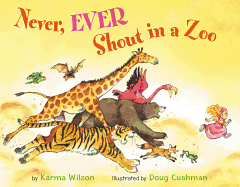
Never, EVER Shout in a Zoo by Karma Wilson

Never, EVER Shout in a Zoo
(Little, Brown Books for Young Readers-2004)
By: Karma Wilson
Illustrated by: Doug Cushman
Grade: PreK-1

Never, EVER Shout in a Zoo is about a little girl that drops her ice cream cone at the zoo and starts to cry despite the narrator's warning, "Never, EVER shout in a zoo...because if you do...anything might happen." From that point it is shown what each of the animals will do (escaping, playing jokes, etc.). In the end the warning is repeated again and now the little girl is careful not to shout again. This is a great cause and effect story. It also can be used to teach rules and why we have them.

Theme/Skills Taught: Consequences/Cause and Effect

About the Author: Karma Wilson grew up an only child of a single mother in the wilds of North Idaho. There was no cable TV.  TV reception was limited to 3 channels, of which one came in with some clarity. Karma did the only sensible thing a lonely little girl could do…she read or played outdoors. By the age 11 she was devouring about a novel a day. Karma never considered writing as a profession because her mother was a professional writer which made it seem like boring and mundane work.Then a tax refund changed everything. With the money the family decided to invest in a computer and Karma started writing for children. She wanted to put a few more good books on the library shelves and pay off that computer! Countless rejections and three years later Karma was finally accepted by book agent Steven Malk (who had already rejected her once, which she never lets him forget). Her first book, Bear Snores On, was released in 2002. The computer was paid for! Since then Karma has had more than 30 books accepted for publication. Karma writes humorous, rhythmic picture books for the very young and books that share her faith in a fun, understandable way with the youngest readers.  Karma Wilson's Bio Her amazing story should inspire everyone! If you put your mind to something, you can do great things! She is proof of that.

About the Illustrator: Doug Cushman was born in Springfield, Ohio and moved to Connecticut with his family when he was 13 years old. While in high school he created comic books lampooning his teachers, selling them to his classmates for a nickel a piece. Since 1978, he has illustrated and/or written over 120 books for children and collected a number of honors including a Reuben Award for Book Illustration from the National Cartoonists Society, New York Times Children's Books Best Sellers, the New York Public Library's Best 100 Books of 2000, and a 2009 California Young Readers medal. He enjoys painting, playing guitar (very ill) and cooking (and eating!) as he spends his time in Paris, France and traveling around Europe and the USA. Doug Cushman's Bio

Pre-Reading Activities: Go over some classroom rules about shouting and why we have certain rules. What do they think the consequences are for breaking these rules? This would be a great book to use in the beginning of the school year to go over school rules and discuss possible consequences for bad behaviors.

Post Reading Activities:  
-Read aloud to the whole class- after every few pages the teacher can stop to talk to the students about what happened (If you scare the bear...he will charge...though the bars of his cage..."). 
-Give students a writing/drawing prompt about why you should never shout in a zoo. Make a poster about a school rule. It is always a good idea to display childrens' work and this would be a great activity to hang in the hall outside the classroom.

The Mixed-Up Chameleon by Eric Carle

The Mixed-Up Chameleon
(HarperCollins-1988)
By: Eric Carle
Grade: K-2

The Mixed-Up Chameleon is about a chameleon that changes colors (like chameleon's do) and is very bored until one day he goes to the zoo. He wished he could be like the other animals and each page he adds another animal part. For example, on the second day he says, "I wish I could be handsome like a flamingo" and he gets wings and feet. By the end he is all mixed-up and cannot catch the fly. Then, he just wishes he was himself so he could catch the fly. It is a great book about self-acceptance and realizing the great qualities we all have!

Theme/Skills Taught: Self-acceptance/ Listening, Writing, Editing and Publishing

About the Author: Eric was born in the U.S. and was raised in Germany. His background is in graphic design but since the late 1960's he illustrated Bill Martin Jr's Brown Bear, Brown Bear, What Do You See?  His illustrations are collages made with his own hand-painted tissue papers, a technique many children have replicated and enjoyed in their classrooms and at home. With his wife Barbara, he is also the co-founder of The Eric Carle Museum of Picture Book Art in Amherst, MA. About Eric Carle

Pre-Reading Activities: What is a chameleon? If you could change colors, what color would you be and why?

Post Reading Activities: Have the students compose a journal entry based on the book's repeating refrain, "I wish I could ____________ like a _______" (i.e. I wish I could fly like a bird). Students will then edit their journal entries and when satisfied, they will transfer their work to the computer, illustrate and publish their work. After reading the story, as a class we could create an art piece using his hand-painted tissue paper technique.

The True Story of the 3 Little Pigs by A. Wolf as told by Jon Scieszka

The True Story of the 3 Little Pigs by A. Wolf
(Puffin-1996)
As told by: Jon Scieszka
Illustrated by: Lane Smith
Genre: Modern Fantasy
Grade: 1-3

The True Story of the 3 Little Pigs by A. Wolf is the "real" story of the three little pigs whose houses are huffed and puffed to smithereens...from a wolf's perspective. This poor, much criticized wolf has gotten a bad reputation. He just happened to be in the wrong place at the wrong time with a sneezy cold, harmlessly trying to borrow a cup of sugar to make his granny a cake. Is it his fault those pigs built insubstantial houses? This is a really funny story and a great book to use to teach comparison and point of view. Most kids know the story of the three little pigs (if they don't, give a brief summary and have other students help). It is really funny to hear the other side of the story. I love using this book to teach kids to listen to all sides of a story before making a decision and to keep this in mind especially when watching the news.

Theme/Skills Taught: Humor & Comedy/Perspectives

About the Author: After reading a few bio's on Jon, he is a very funny author. He has a website dedicated to him and his books and it is really funny to read. Jon Scieszka's Bio He was born in flint Michigan and is one of six boys! Jon thought about being a doctor, but decided to write instead and graduated with his MFA in Fiction at Columbia University. Then, he painted apartments and became a school teacher, teaching a range of grades. He found the best audience for the books he was writing and took a year off to write stories for kids. Through his wife, he met Lane Smith who loved his book A Wolf's Tale and drew some illustrations for it, but still got rejected by publishers. In 1989 Viking Books liked the book, changed the title to The True Story of the Little Pigs, and published it. Since then he has sold 11 million copies around the world and won a few awards! He is a great author and a really funny individual!
About the Illustrator: Lane Smith was born in Tulsa, Oklahoma on August 25th, 1959. His family moved to Corona, California when he was three, but spent the better part of every summer back in Oklahoma. "My family would take the old Route 66 highway. I think that's where my bizarre sense of design comes from. Once you've seen a 100-foot cement buffalo on top of a donut-stand in the middle of nowhere, you're never the same." After high school Lane worked as a janitor at Disneyland for five years. After he graduated from college with a B.F.A. in Illustration, he headed for the Big Apple with a small portfolio of illustrations. His work is is rendered in oil paints. He paints on board, building up several thin glazes of the oil, sealing them between coats with an acrylic spray varnish. This not only dries the oil instantly, but also causes a chemical reaction between the oil and the acrylic. Normally, it would be a mistake to combine two opposites like this and in fact it was a mistake the first time I did it, but I liked the results. "I hope I can follow the path these dark illustrators have walked, or at least use the sidewalk that runs alongside it." The two of them, Lane and Jon make a great pair with their talent and humor. Lane Smith's Bio


Pre-Reading Activities: Discuss as a class how there are always two sides to a story. Ask them to share a situation where they saw a different view than a friend did. Also, you will have to go over the original story to make sure all students have read it and if they haven't give a brief synopsis, asking other students to help.

Post Reading Activities: Have children write their own versions of a fairy tale with a twist- Have students brainstorm things that happened in the Three Little Pigs story that didn't happen in the true story (compare/contrast).

Frog and Toad Are Friends by Arnold Lobel

 Frog and Toad Are Friends
(HarperCollins-1979)
Written and Illustrated by: Arnold Lobel
Grade: 2
*Caldecott Honor Book 1971*

Frog and Toad Are Friends is a collection of four short stories: Spring, The Story, A Lost Button, A Swim and The Letter. All of these stories portray frog and toad as best friends. They show that Frog and Toad are always there for each other in good times and bad and they help each other out when they need it. It is a great story about friendship and has very simple vocabulary for younger kids to read. I love all the exclamation so the kids can learn to read with expression. Since there are a few books about frog and toad, this book can spark their interest to read more books!

Theme/Skills Taught: Friendship & Diversity/Comparing Characters

About the Author/Illustrator: Arnold Lobel grew up in Schenectady, New York, where he lived with his grandparents. When he graduated from art school, he married Anita Kempler, and they moved to New York. He and his wife had two children, Adam and Adrianne.When he first started drawing pictures for children's books, Arnold Lobel got many of his ideas from the cartoons his children liked to watch. He has actually written a few books about frog and toad including Days with Frog and Toad, Frog and Toad All Year, and Frog and Toad Together. All of them are great books and kids love to read them! Arnold Lobel's Bio
Pre-Reading Activities: Give students a background on Arnold Lobel. He began getting his ideas for illustrations based on cartoons. This may give students some ambition to want to draw OR have them think of something they love to do. It can become a career if you pursue it and are determined enough.

Post Reading Activities: The students will create and complete a Venn Diagram chart that compares and contrasts Frog and Toad based on the five stories they read.

Wednesday, September 7, 2011

If You Take a Mouse to the Movies

If You Take a Mouse to the Movies
(HarperCollins-2000)
By: Laura Numeroff
Illustrated by: Felicia Bond
Grade: 2-3

If You Take a Mouse to the Movies portrays the mouse from If You Give a Mouse a Cookie in a holiday tale. This time, if you take him to the movies, he'll ask you for some popcorn. If you give him the popcorn, he'll want to string it all together. Then he'll want to hang it on a Christmas tree. This mouse is almost never satisfied; once he gets what he asks for, he wants something else. This book is great for younger children to teach them predicting. They can use picture clues to guess what they mouse wants to do next. I love this book because it really capture the holiday spirit.

Theme/Skill: Cause and effect and predicting.

About the Author:
Laura Numeroff was born in 1953, in Brooklyn, New York.  I was surrounded by art, music, and books. Her father, William, worked on the art staff of the World Telegram & Sun, one of New York's major newspapers. Her mother, Florence, was a junior high school home economics teacher.  
She started writing her own stories and drew pictures to go with them. She would make a bookcover for them and write down the name of a publisher. She had a library 5 blocks from her house and she became addicting, renting as many books as were allowed. She briefly wanted to follow in her sister's path to become a fashion designer but soon realized that was not for her. She ended up graduating college with a degree and a contract for her first book! She is a very talented book author. Laura Numeroff's Bio

Pre-Reading Activities: Brainstorm- What will happen if you take a mouse to the movies? It would be really cute to see how the students' brains work and the situations they could come up with.

Post Reading Activities: Give the students story starters and make them create their own story. Laura has numerous books that begin "if you take a mouse...", "if you give a mouse...". Give students options and allow them to create their own plot and characters.

Miss Nelson is Missing by Harry Allard & James Marshall

Miss Nelson is Missing
(Sandpiper-1985)
By: Harry Allard & James Marshall
Grade: 1st

Miss Nelson had the worst class in the entire school. Her students wouldn't listen to her, were rude, and never did any of the homework that was assigned to them. One day, Miss Nelson didn't show up to school and the students had a scary, mean teacher (Miss Nelson dressed up) show up instead. The students began to miss Miss Nelson and were wondering where she went. Then, Miss Nelson finally comes back to school and her students were grateful and acting appropriately.I love this book because it teaches students to not take things for granted and to be grateful for the kind people that surround us. It is a great introduction to classroom rules and why it is important to follow them.

Skill Taught: Sequencing


Theme: Respect, Teamwork, Fairness, Responsibility and Kindness


About the Authors: Harry Allard was born in Evanston, Illinois on January 27th. He grew up in California, Long Island, and Chicago. He graduated from Northwestern College in 1943 and then performed active duty in Korea. He then lived in Paris for several years and became so fluent in the language that he got a master's degree and then a Ph.D. in French from Yale in 1973. He taught French at the college level for many years.
Upon his arrival in Boston, he met James Marshall, whose art and friendship inspired Allard's first book, The Stupids Step Out. This successful collaboration paved the way for the publication of other Stupids books and the Miss Nelson series. Miss Nelson is Missing was voted one of the most memorable books of the century.
Mr. Allard lives and works in Massachusetts Harry Allard Bio

Pre-Reading Activities
: Go over troubling vocabulary (arithmetic, squirmed, rapped, gobbled, etc).This will make for a smoother read. If you have time, you can start them with a vocabulary journal.

Post Reading Activities:
-After reading the book, the students will divide a piece of paper into three sections and draw and write the beginning, middle and end of the story.
-Brainstorm classroom rooms for Room 207 to follow
-Create a missing poster for Miss Nelson
-Practice fluency doing a reader's theater Miss Nelson is Missing Reader's Theater

Tuesday, September 6, 2011

The Polar Express by Chris Van Allsburg

The Polar Express
(Houghton Mifflin-2009)
Written and Illustrated by: Chris Van Allsburg
Grades: 1-2
*Caldecott Award 1986*

The Polar Express is about a boy who is listening for the bells of Santa's sleigh and hears a steam engine outside his house instead. The conductor invites him to board the Polar Express, a train filled with children on their way to the North Pole. The train takes the children to the center of the city, where Santa and the elves have gathered for the giving of the first gift of Christmas. The boy is chosen to receive this first gift. Knowing that he can choose anything in the world, he decides on a simple gift: one silver bell from Santa’s sleigh. When the children return to the train, the boy realizes the bell has fallen through a hole in his pocket. Heartbroken, he is returned to his home. In the morning, his little sister finds one small box with the boy’s name on it among the presents. Inside is the silver bell! The boy and his sister are enchanted by its beautiful sound, but their parents cannot hear it. The boy continues to believe in the spirit of Christmas and is able to hear the sweet ringing of the bell even as an adult. I love this book because it brings out the true hopefulness of Christmas. The characters are great in the story and students can really relate.

Theme: Faith (seeing is not necessary believing)

About the Author: Chris was born in Grand Rapids, Michigan on June 18th, 1949, the second child. During junior and senior high school in East Grand Rapids, Chris didn't take art classes and was instead interested in math and science. An admissions officer from the University of Michigan came to Chris's high school and explains the college of Architecture and Design. Chris loved to draw but was not aware one could go to school to study art. This was the last year the University admitted art students without a portfolio (lucky for Chris). Because he had not taken art in his high school years, the officer questioned his qualifications. The officer tested Chris asking his opinions on Normal Rockwell. Chris assumed correctly, that he was a fan of the writer, and told him he thought he was wonderful. Chris was accepted. He graduated in 1972 and went to graduate school at the Rhode Island School of Design (RISD) to continue his study of sculpture. In 1975, after earning his M.F.A. degree at RISD, Chris set up a sculpture studio in Providence, RI and got married. He did not think of his drawings were very important, but others did. Alan Stone showed two of them to a curator from The Whitney Museum of Art, where they were exhibited in 1978.  His wife encouraged Chris to consider making illustrations for a story book. A friend of Lisa’s, illustrator and author David Macaulay agreed with Lisa that the kind of pictures Chris was making could be effective book illustration.  Though still involved in making sculptures, Chris set aside some time and created the story and pictures that became The Garden of Abdul Gasazi, published in 1979. Since then, Chris has written and illustrated 15 books and has illustrated three others that were written by Mark Helprin. Chris Van Allsburg's Bio
Pre-Reading Activities: Show the class the cover of the book and read the title. Have the class predict what the Polar Express is.


Post Reading Activities: For a treat during Christmas, give the students a paper bell to decorate and wear around their necks. 
-Go over vocabulary terms (conductor, rustle, pranced, nougat, flickered, paced, desert, harness, lurc)
-Emotions Chart
Emotion
Why Did the Boy feel that way?
When do you feel that way?
Curious
 
 
Excited


Great lesson ideas